Healthcare is transforming at lightning speed, and the need for secure, efficient healthcare communication platforms is more urgent than ever in 2026.
Providers now face daily hurdles like fragmented messaging, strict compliance demands, and patients who expect fast, seamless digital interactions. Navigating these challenges can feel overwhelming, especially as technology evolves.
This article will guide you through the 7 top healthcare communication platforms that are redefining how patients and providers connect in 2026. We’ll break down each platform’s features, pricing, pros and cons, and best use cases, giving you the insight needed to choose confidently.
Ready to discover the solutions that will elevate your practice? Let’s dive in and find the best fit for your needs.
What Makes a Healthcare Communication Platform Essential in 2026?
Healthcare communication platforms are no longer a luxury—they’re an absolute necessity for modern providers. As the healthcare landscape goes digital, these platforms bridge the gap between patients and care teams, driving efficiency and better outcomes.
The Shift Toward Digital-First Healthcare Communication
The last few years have seen a dramatic shift toward digital-first healthcare communication platforms. Patients now expect instant, secure connections with their providers, whether it’s for scheduling, follow-ups, or quick questions. Over 70% of people prefer digital communication for healthcare appointments and reminders, a figure that keeps climbing each year.
This rapid change is fueled by both convenience and the need for compliance. Regulations like HIPAA and GDPR require healthcare communication platforms to keep patient data safe and private. Providers are seeking solutions that streamline workflows, maintain compliance, and deliver the fast, multi-channel experiences patients demand. For a deeper dive into these solutions, explore this Healthcare Communication Tools Overview.
Key Features Healthcare Providers Demand
What sets top healthcare communication platforms apart? It comes down to a core set of features:
- Secure, HIPAA-compliant messaging and data storage
- Multi-channel communication: SMS, email, voice, video, patient portals
- Seamless EHR and EMR integrations to eliminate manual entry
- Automation for reminders, intake forms, and billing notifications
- Scalability to support small clinics or large health systems
These must-haves ensure that healthcare communication platforms not only improve efficiency but also safeguard sensitive information and adapt to any organization’s needs.
The Impact on Patient Outcomes and Staff Efficiency
Healthcare communication platforms directly influence patient outcomes and staff workload. Automated reminders reduce no-shows, while real-time messaging boosts patient satisfaction and loyalty. Staff benefit from workflow automation, experiencing less burnout and fewer repetitive tasks.
In fact, telehealth adoption powered by advanced healthcare communication platforms has increased patient reach by over 30% in some systems. This translates to more engaged patients and more time for staff to focus on care instead of paperwork.
Challenges in Selecting the Right Platform
Despite the clear benefits, choosing among healthcare communication platforms can be challenging. Providers need to balance compliance, ease of use, and cost. The crowded market means many platforms offer similar features, which complicates decision-making.
Integration with existing EHR or billing systems is another major hurdle, especially for organizations with legacy tech. Staff training and patient adoption are crucial as well. Without buy-in from both groups, even the best healthcare communication platforms can fall short of their potential.
Trends to Watch in 2026
Looking ahead, healthcare communication platforms are embracing cutting-edge trends. Expect to see:
- AI-driven conversational agents for round-the-clock patient support
- Multilingual communication capabilities for diverse populations
- Real-time analytics that help providers deliver proactive care
- A push toward interoperability and open APIs for seamless integration
These trends signal that healthcare communication platforms will continue to evolve, making digital engagement more inclusive, intelligent, and impactful for everyone involved.
7 Top Healthcare Communication Platforms to Try in 2026
Choosing the right healthcare communication platforms in 2026 can be a game-changer for your practice. With so many options available, it’s essential to evaluate each solution’s strengths, pricing, and ideal use cases. Below, we break down seven leading platforms that are raising the bar for patient and provider communication.
For more in-depth reviews and insights on these and other patient engagement solutions, check out our curated Patient Communication & Engagement Tools collection.
OhMD
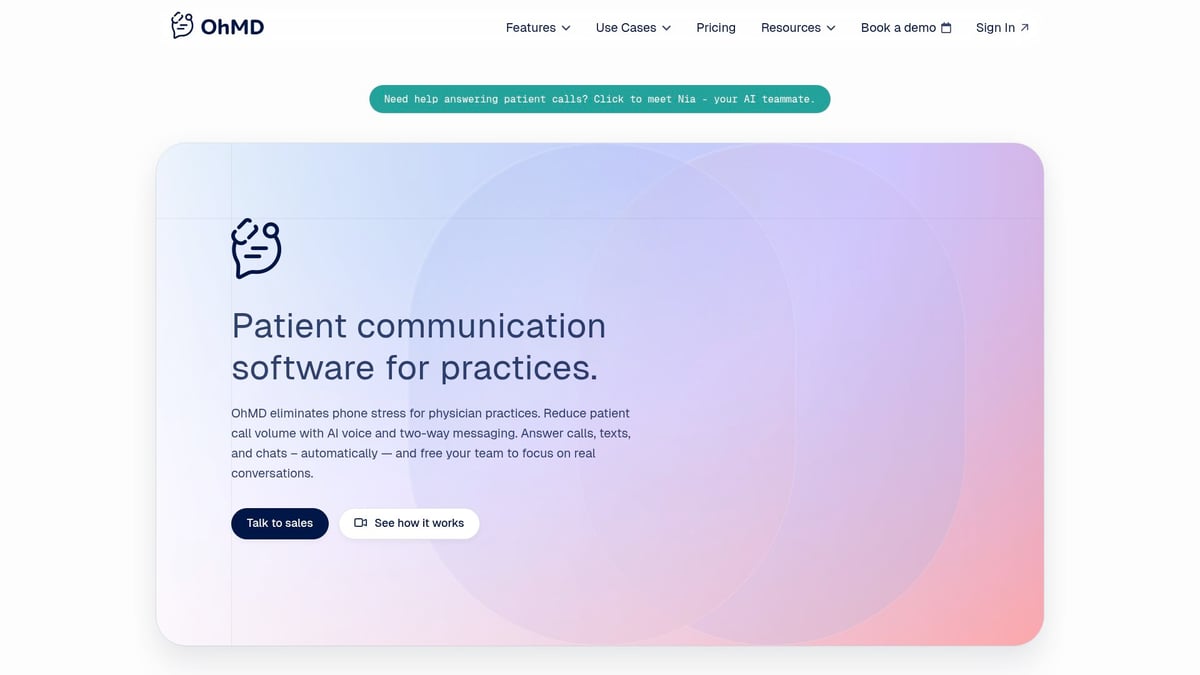
OhMD stands out among healthcare communication platforms for its text-first approach and seamless integration with over 85 EHRs. Pricing starts at $250 per month for the basic plan, making it accessible for many practice sizes.
Core Features:
- AI assistant (Nia) for automating common workflows
- Secure two-way messaging between patients and providers
- Online forms, video visits, and web chat
- Call handling to reduce phone traffic
Unique Benefits:
OhMD’s intuitive interface simplifies patient outreach and reduces staff phone time by up to 40 percent. Its robust automation and HIPAA compliance ensure secure, efficient communication.
Ideal For:
Practices wanting to streamline patient communication without complex onboarding or expensive add-ons.
Pros:
- High patient adoption rates
- Strong EHR integrations
- Automated reminders and follow-ups
Cons:
- Basic plan lacks some advanced automation tools
- Some users report a learning curve
Example:
A multi-specialty clinic decreased staff phone time by 40 percent after implementing OhMD’s AI-powered messaging.
Klara
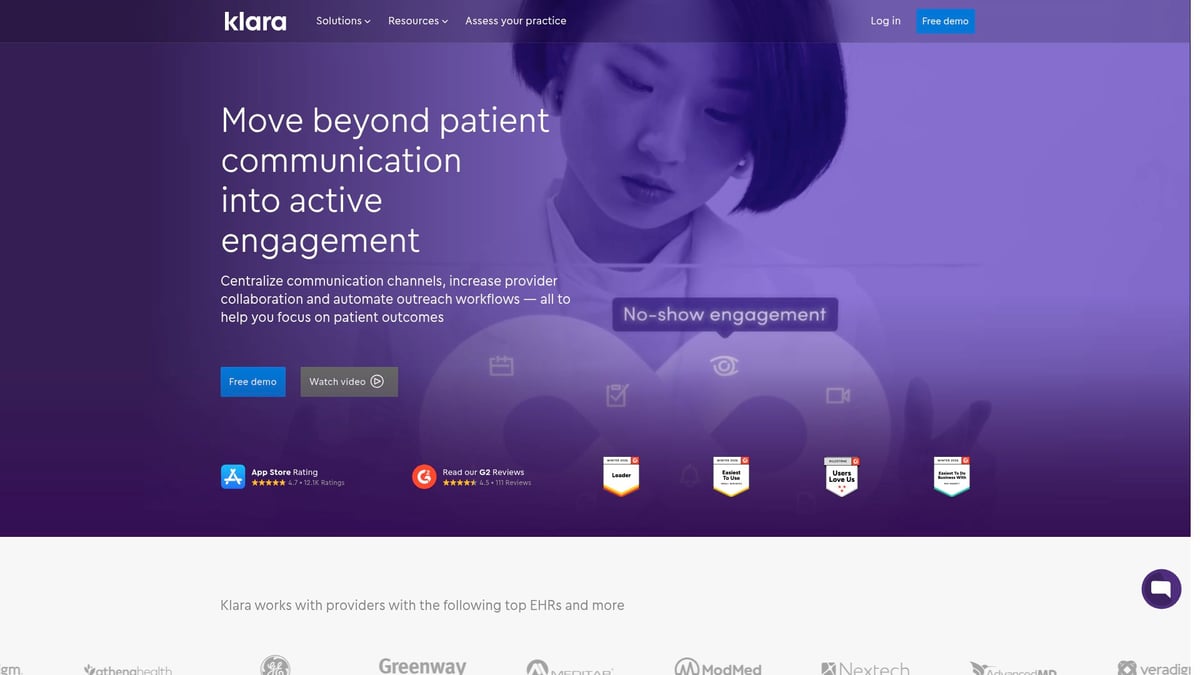
Klara is a central hub for healthcare communication platforms, offering a multi-channel messaging system and workflow automation. Pricing is custom, so you’ll need to contact them for an exact quote.
Core Features:
- Multi-channel messaging: text, webchat, call-to-message
- No-login patient access, reducing friction
- Automated outreach and voice-to-text transcription
- Integrates with 50+ EHR and practice management systems
Unique Benefits:
Klara eliminates the need for app downloads, helping patients connect instantly. Its centralized inbox drastically reduces inbound calls.
Ideal For:
Practices looking to minimize front desk interruptions and streamline communications.
Pros:
- Easy for patients to access
- Automated, encrypted messaging
- Reduces administrative workload
Cons:
- EMR integration can be complex at setup
- Opaque pricing, potentially costly for small practices
Example:
Clinics report a 60 percent reduction in phone calls after switching to Klara.
CipherHealth
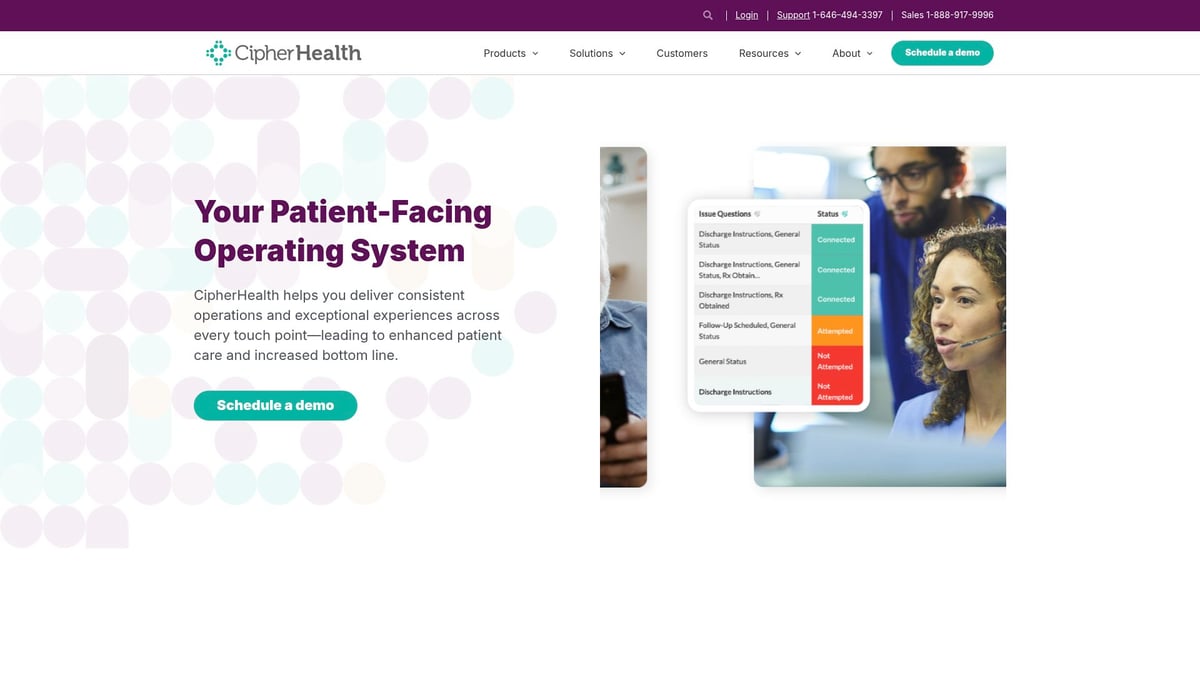
CipherHealth is designed for hospitals and large health systems, focusing on post-discharge follow-up and patient outreach. Pricing is custom and tailored to organizational needs.
Core Features:
- Automated reminders and follow-ups via calls, texts, and emails
- Patient surveys and feedback collection
- Analytics dashboards to track engagement
- EHR integration for seamless data flow
Unique Benefits:
CipherHealth’s rapid deployment means systems can go live in days, not months. It connects with 2.5 percent of the US population, showcasing its scalability.
Ideal For:
Hospitals and health systems prioritizing patient experience and clinical results.
Pros:
- Multilingual messaging support
- Fast setup and robust compliance
- Strong analytics capabilities
Cons:
- Limited customization for unique workflows
- Initial navigation may feel confusing
Example:
Hospitals using CipherHealth improved post-discharge follow-up rates by 25 percent.
Luma Health
Luma Health is a comprehensive solution among healthcare communication platforms, offering AI-driven patient engagement and automation. Pricing averages around $250 per user monthly, with custom quotes for larger systems.
Core Features:
- AI-driven Patient Success Platform
- Smart scheduling and automated waitlists
- Digital intake forms and insurance checks
- Personalized reminders
Unique Benefits:
Luma Health automates the entire patient journey, from appointment scheduling to post-visit follow-ups. Its integration flexibility makes it compatible with most healthcare tech stacks.
Ideal For:
Healthcare systems seeking to automate and personalize every touchpoint in the patient journey.
Pros:
- Deep automation and mobile-friendly
- High integration flexibility
- Reduces staff workload
Cons:
- Feature-rich interface may require onboarding
- Higher cost for small practices
Example:
Practices saw a 30 percent reduction in no-shows and significant staff time savings after adopting Luma Health.
Updox
Updox is an all-in-one healthcare communication platform, especially popular with small and medium-sized practices. Pricing starts at $149 per month for basic plans.
Core Features:
- Universal inbox for messages, faxes, and documents
- Telehealth video chat and patient portal
- Integrated payments and eFax
- Automated reminders
Unique Benefits:
Updox eliminates the need for extra hardware or app downloads. Its integrated payment solutions and document management are especially helpful for front office teams.
Ideal For:
Small to medium practices wanting affordable, comprehensive communication tools.
Pros:
- Easy to implement and use
- Strong document management
- Built-in telehealth and reminders
Cons:
- Interface can feel dated
- Occasional video lag
- Some users desire a more modern UI
Example:
Clinics improved payment collections and streamlined document workflows using Updox.
Artera
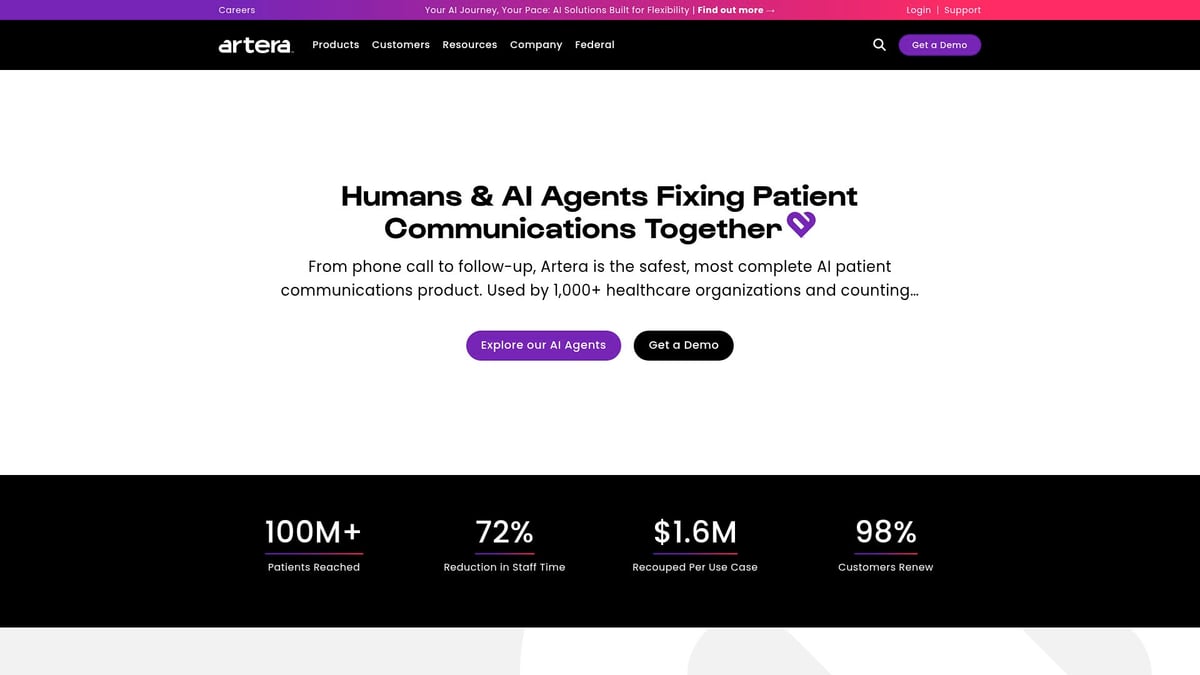
Artera takes healthcare communication platforms to the enterprise level, offering powerful AI and multilingual support. Pricing starts from $15,000 per year.
Core Features:
- AI virtual agents and Staff AI Co-Pilot
- Supports communication in 109 languages
- Call-to-text conversion and EHR integrations
- Automated workflows for scheduling, intake, and billing
Unique Benefits:
Artera unifies all patient interaction threads, from self-scheduling to billing, into one platform. Its advanced community outreach is ideal for large, diverse organizations.
Ideal For:
Large healthcare enterprises needing scalable and multilingual patient engagement.
Pros:
- Broad language support
- Deep EHR integration
- Powerful automation for large organizations
Cons:
- High starting price
- Implementation can be complex
- Occasional EHR sync issues
Example:
Organizations improved multilingual outreach and response rates by using Artera to support diverse populations.
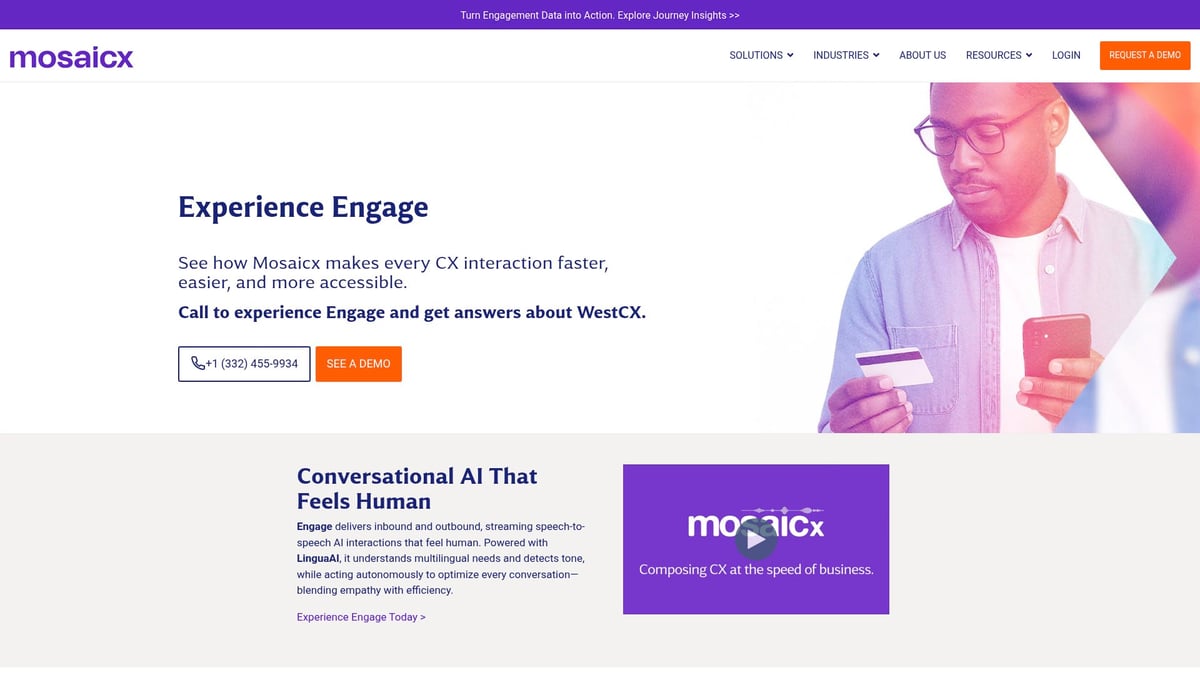
Mosaicx
Mosaicx is a leader in AI-driven healthcare communication platforms, focusing on advanced self-service and analytics. Pricing is custom, tailored to enterprise needs.
Core Features:
- AI-driven voice and text automation
- Omnichannel outreach: calls, texts, and more
- Real-time analytics dashboards
- 24/7 self-service for patients
- Rapid deployment
Unique Benefits:
Mosaicx’s conversational AI mimics real human interactions, providing a seamless patient experience. It integrates quickly with existing systems and offers robust compliance features.
Ideal For:
Enterprises seeking advanced self-service, deep analytics, and secure communication.
Pros:
- Fast setup and comprehensive analytics
- Reduces staff burden
- Strong security and compliance
Cons:
- Custom pricing may be higher for smaller organizations
- Requires some IT resources for integration
Example:
Enterprises reported improved patient satisfaction and operational efficiency after deploying Mosaicx.
Quick Comparison Table
| Platform | Best For | Pricing (from) | AI/Automation | Multilingual | EHR Integration | Key Benefit |
|---|---|---|---|---|---|---|
| OhMD | Practices of all sizes | $250/month | Yes | No | 85+ EHRs | Intuitive, text-first design |
| Klara | Streamlined comms | Custom | Yes | No | 50+ EHRs | No-login, multi-channel comms |
| CipherHealth | Hospitals/health systems | Custom | Yes | Yes | Yes | Post-discharge follow-up focus |
| Luma Health | Automated engagement | $250/user/mo | Yes | No | Most systems | End-to-end journey automation |
| Updox | Small/medium practices | $149/month | Some | No | Yes | All-in-one, easy to implement |
| Artera | Large enterprises | $15,000/year | Yes | 109 | Yes | Multilingual, unified workflows |
| Mosaicx | Advanced analytics | Custom | Yes | Yes | Yes | Conversational AI, self-service |
These healthcare communication platforms are transforming how providers connect with patients in 2026. By evaluating features, pricing, and use cases, you can find the right fit for your organization’s needs.
How to Choose the Best Healthcare Communication Platform for Your Organization
Selecting the right healthcare communication platforms can feel overwhelming with so many options available. The right choice impacts not only your workflows but also patient satisfaction and operational efficiency.
Assessing Your Organization’s Unique Needs
Start by mapping out your organization’s core requirements. Are you a small clinic, a large multi-site system, or a specialty provider? Each group has different needs from healthcare communication platforms.
Consider your patient demographics and their preferred ways of interacting with your team — do they want texts, emails, or phone calls? Integration is another factor. Do you need the platform to connect with your EHR, billing, or workflow tools? Finally, put compliance and data security at the top of your checklist, especially for HIPAA and SOC 2.
Key Evaluation Criteria and Decision Factors
Once you know your needs, it’s time to evaluate your options. Assess usability for both staff and patients. Can the platform scale as your organization grows? Automation features like reminders and digital intake can save hours each week. Analytics are vital — platforms offering actionable insights help you continuously improve. For more on analytics and intelligence tools that enhance communication, visit Analytics & Intelligence in Healthcare.
Support and training resources are crucial, as is balancing cost versus value. Here’s a quick table to help compare:
| Criteria | Importance | Example Questions |
|---|---|---|
| Usability | High | Is it easy for staff and patients? |
| Scalability | Medium/High | Will it fit future growth? |
| Automation | High | What processes are automated? |
| Analytics | High | Are insights easy to access? |
| Support | Medium/High | Is help available when needed? |
| Cost | High | Are there hidden fees? |
Real-World Selection Scenarios
Different organizations benefit from different healthcare communication platforms. Small practices often value simplicity and cost-effectiveness, with solutions like Updox or OhMD. Large health systems may seek advanced automation, multilingual support, and deep integration, making platforms like Artera or CipherHealth a better fit.
Dental and specialty clinics can benefit from tailored workflows and robust patient engagement tools. Always align your choice with your organization’s daily realities and long-term goals.
Avoiding Common Pitfalls
Common mistakes when selecting healthcare communication platforms include overlooking hidden costs or integration challenges. Involve both staff and patients in the decision-making process so the solution fits real-world needs.
Don’t choose a platform that won’t scale as you grow. Future-proofing is essential. Make sure you fully understand the onboarding process and support provided.
Maximizing Adoption and ROI
To get the most from healthcare communication platforms, invest in thorough staff training and onboarding. Share the benefits with your patients to encourage engagement and smooth adoption.
Regularly review analytics to identify workflow bottlenecks and improve patient satisfaction. This ongoing review ensures you continue to see value and adapt as needs evolve.
Key Trends and Innovations in Healthcare Communication for 2026
The landscape of healthcare communication platforms is rapidly changing in 2026. Providers and patients expect smarter, faster, and more secure ways to connect. Let’s explore the major trends shaping these platforms and how they are redefining the future of healthcare engagement.
AI and Automation Revolutionizing Patient Engagement
Artificial intelligence is at the heart of modern healthcare communication platforms. AI-driven virtual assistants now handle appointment scheduling, symptom triage, and 24/7 patient inquiries. These conversational agents deliver quick responses and automate routine tasks, freeing up staff for more complex care.
According to PAME-AI: AI in Patient Messaging, AI-powered messaging strategies are optimizing not just speed but also the relevance of patient communications. Smart automation ensures reminders, follow-ups, and patient education are timely and personalized. This shift boosts efficiency and enhances the patient experience.
Multilingual and Inclusive Communication
Inclusivity is a top priority for healthcare communication platforms in 2026. Leading solutions now support over 100 languages, making healthcare accessible to diverse populations. Features like voice-to-text, screen reader compatibility, and simplified mobile interfaces ensure everyone can engage easily.
Practices using platforms with advanced language support report higher satisfaction rates among patients who speak languages other than English. This focus on inclusivity helps bridge gaps in care and builds stronger patient-provider relationships.
Seamless Interoperability and Open APIs
Healthcare communication platforms have become much more flexible, thanks to open APIs and improved interoperability. Providers can now connect their communication tools with EHRs, billing systems, and even third-party health apps.
Seamless integration reduces manual data entry and minimizes errors. It also enables custom workflows tailored to each organization’s unique needs. As a result, clinicians and staff spend less time switching between systems and more time focusing on patient care.
Real-Time Analytics and Proactive Care
Analytics are transforming how organizations use healthcare communication platforms. Real-time dashboards display patient engagement, appointment no-shows, and response rates. This data-driven approach helps providers identify trends and intervene with at-risk patients before issues escalate.
A recent report on Digital Transformation in Healthcare Statistics shows that predictive analytics and actionable insights are now key drivers of operational improvements. With these tools, practices can optimize staffing and deliver more proactive, personalized care.
Enhanced Security and Compliance
Privacy remains non-negotiable for healthcare communication platforms. The latest solutions feature advanced encryption, automated consent management, and detailed audit trails. Compliance with HIPAA, SOC 2, and other standards is built in from the ground up.
Automated breach notifications and ongoing security updates further protect sensitive patient data. This gives both providers and patients confidence that their information is safe and handled with the utmost care.
Patient-Centric Design and Mobile Experience
User experience is central to adoption in 2026. The best healthcare communication platforms offer intuitive, mobile-first designs that require no downloads or logins. Patients can communicate, complete forms, or schedule visits with just a few taps.
Built-in feedback tools and satisfaction surveys help organizations continually improve their services. By prioritizing ease of use and accessibility, these platforms drive higher engagement and loyalty.
Frequently Asked Questions About Healthcare Communication Platforms
Healthcare communication platforms are transforming how providers and patients connect in 2026. With so many options, you may have questions about features, compliance, integration, and value. Below, we answer the most common questions to help you navigate your choices.
What is a healthcare communication platform and how does it differ from standard messaging tools?
Healthcare communication platforms are purpose-built for medical environments. Unlike basic messaging apps, they offer secure, HIPAA-compliant tools for patient-provider conversations, appointment scheduling, reminders, document sharing, and more. These platforms streamline workflows and centralize all interactions in one place.
How do these platforms ensure HIPAA compliance and data security?
They use end-to-end encryption, secure authentication, audit trails, and strict access controls to protect sensitive data. Many also undergo third-party security audits and comply with regulations like HIPAA and GDPR. For more details on secure messaging market trends and compliance, explore Secure Messaging in Healthcare Market Trends.
What are the most important features to look for in 2026?
Look for multi-channel messaging, robust EHR integration, automation for reminders and intake, analytics dashboards, and support for video visits. Scalability, multilingual support, and AI-driven tools are also becoming essential in healthcare communication platforms.
How do pricing models typically work—are there hidden fees?
Pricing varies by provider. Some offer monthly subscriptions per provider, while others require custom quotes. Always ask about setup fees, integration costs, and additional charges for premium features to avoid surprises.
Can these platforms integrate with any EHR or practice management system?
Most leading healthcare communication platforms offer integrations with popular EHR and practice management systems. However, compatibility may vary, so confirm integration capabilities with your vendor before committing.
What onboarding and training support is available for staff?
Vendors typically provide onboarding sessions, training materials, and dedicated support teams. Some offer in-app tutorials, webinars, or 24/7 support to ensure smooth adoption and ongoing success.
How do these solutions improve patient outcomes and operational efficiency?
Healthcare communication platforms reduce missed appointments, streamline administrative workflows, and enhance patient satisfaction through fast, personalized communication. This leads to better engagement and improved health outcomes.
Are there platforms specifically tailored for dental, specialty, or small practices?
Yes, some healthcare communication platforms cater to dental and specialty practices, offering customized workflows and digital forms. For reviews and options, see Dental Software Scheduling & Forms.
What are common challenges during implementation and how can they be mitigated?
Challenges include staff resistance, data migration, and integration hurdles. To mitigate these, involve your team early, request vendor support, and pilot the platform before full rollout.
How can organizations measure the ROI of their communication platform investment?
Track metrics like reduced no-shows, increased patient engagement, staff time saved, and improved patient feedback. Many platforms provide analytics to help you monitor and optimize your investment in healthcare communication platforms.